Poets and Critics

Showing posts with label Peter Gizzi. Show all posts
Showing posts with label Peter Gizzi. Show all posts
Tuesday, June 26, 2012

Robert Hampson on Peter Gizzi's Threshold Songs
Peter Gizzi: Threshold
Songs
#
The volume
inhabits the poetic world of the four elements – air, earth, fire & water –
that is also the world of atoms & electrons, particles & waves, DNA
&CGI.
#
It is a work of
mourning - from the technology of hospitalised dying:
When those green
lights flash & blink, is that it? When the ‘it’ continues strangely for a
bit, then falls into a line, is it over?
To the mythic
realm of Orpheus, of Thoth & Anubis of the Egyptian death cult, of Charon
and Mercury, of the Bardo Thodol.
Myths of attempted (& failed) rescue & recovery of the dead; of
judgement; of the process of dying & the liminalities of the after-death:
Is there a
world?
Are they still
calling it that?
The after-death of
Bardo – with its lights & colors – that maps onto modern clinical accounts
of the brain closing down – is also the poetical world of this volume – but cut
with folk tales in their multiple versions.
#
Between the
dedication ‘called back’ and the epigraph from Beckett (‘a voice comes to one in
the dark’), the volume situates itself at the start in the liminal space of
grieving and haunting – the two-way movement between our yearning for the dead
– and the dead haunting us: ‘felt presences/ behind the hole/ in the day’. Gaps
& absences, but also revenants, ghosts, memories – the otherwise present.
#
At the same time,
the poetry apprehends another threshold: ‘death we carry/ within us’: the
nature of living in time:
now that you’re
gone
& I’m here
or now
that you’re here
&
I’m gone or now
that you’re gone
&
I’m gone what
did we learn?
In short,
negotiating the facts of ‘time-based carbon life’: a relationship to mortality
that is a way of valuing life.
#
A childhood world
of snowglobes, Pinocchio, cartoons as trace. At the same time, what seems often
like a non-specific location that crystallises momently as New
England through specifying lexis. A planetary awareness of ‘deep
space’ – ‘stars scattered’, ‘solar wind’, ‘planet spin’ – Pascall’s terrifying
interstellar spaces – but also a vantage point – like the posthumous
perspective – a distance – like the mediated vision of lens & telescope.
Wednesday, June 13, 2012
David Nowell Smith on Peter Gizzi's "Correspondence of the Book" in A Poetics of Criticism
On Coherence and Correspondence: Peter Gizzi.
 In the blurb to A Poetics of Criticism, we are told that
the essays collected within, including ‘Correspondences of the Book’, ‘perform
the compositional mutation of enacting as they tell... explore the fluidities
and possibilities within a poetics of criticism’. I must say I’m always suspicious of the language of enacting and performance,
not out of some conservative grumpiness but rather the opposite: a worry that
latent in the enactment-telling distinction we actually find form and content
being replayed, when at its most powerful ‘performance’ should be able to short
circuit such a reductive approach. And yet, reading ‘Correspondences of the
Book’, I find myself in the slightly invidious situation of asking at certain
moments, ‘what is the main claim?’, or ‘what is the central argument?’. Maybe
this is a hangover from endless weeks of marking student essays, but I think it
might point to something more interesting happening in Gizzi’s essay (if
‘essay’ it is). As it strikes me, the essay uses the declarative sentence, the
assertive judgment, in such a way as to imply a ‘content’, but sets up
correspondences between these declarative sentences which will resist their
cohering into an ‘argument’. The sentences claim something, certainly, claim a
good many things, but they do not thereby become ‘claims’. The essay demands
that we read within this double-bind.
In the blurb to A Poetics of Criticism, we are told that
the essays collected within, including ‘Correspondences of the Book’, ‘perform
the compositional mutation of enacting as they tell... explore the fluidities
and possibilities within a poetics of criticism’. I must say I’m always suspicious of the language of enacting and performance,
not out of some conservative grumpiness but rather the opposite: a worry that
latent in the enactment-telling distinction we actually find form and content
being replayed, when at its most powerful ‘performance’ should be able to short
circuit such a reductive approach. And yet, reading ‘Correspondences of the
Book’, I find myself in the slightly invidious situation of asking at certain
moments, ‘what is the main claim?’, or ‘what is the central argument?’. Maybe
this is a hangover from endless weeks of marking student essays, but I think it
might point to something more interesting happening in Gizzi’s essay (if
‘essay’ it is). As it strikes me, the essay uses the declarative sentence, the
assertive judgment, in such a way as to imply a ‘content’, but sets up
correspondences between these declarative sentences which will resist their
cohering into an ‘argument’. The sentences claim something, certainly, claim a
good many things, but they do not thereby become ‘claims’. The essay demands
that we read within this double-bind.
And
so, the question I wish to pose of this essay is the following: in what ways
does this essay cohere? What kind of coherence is at issue?
Firstly,
we can note two apparently conflicting assertions on coherence, given in close
proximity:
The true
test of poetry is in its ability to endure and cohere in time (180).
Do not try
to make it all cohere (181).
There is another
disjuncture in these two assertions: both come after a citation, the first from
Jack Spicer, the second from John Ruskin. Yet if the latter is paraphrase, the
former does not, at least at first, bear any obvious relation to the Spicer
quote: To make things visible rather than
to make pictures of them (phantasia non imaginari). If this is to be a claim
about coherence in time rather than about making-see versus representing (lamp
versus mirror in Abrams’s famous distinction) then sotto voce the correspondence of quote and paraphrase demands us to
surmise that making-visible, even visibility itself, are temporally
conditioned.
Perhaps
a key word here is that almost inconspicuous ‘all’: the coherence of poetry is
not a totalising coherence. Again, it strikes me that what is at issue is time:
to make ‘all’ cohere will not allow for temporal change; coherence must
‘endure’, rather than impose itself as a single moment imposes itself over
time.
But
does this insight into time itself, as it were, endure throughout the essay?
What I’ve identified here, somewhat tentatively, is a thinking of
‘in-time-ness’: coherence is always temporal. Yet when Gizzi speaks of the
‘real’, he suggests this lies outside
time. Here I see a series of associative moves which I suspect come from
Lévinas. We start with the ‘image’ (how does this relate the ‘picture’ that
Spicer denigrates for poetic phantasias?),
‘which is always the image of the face—our own and those of our masters—[and]
remains broken and separate from ourselves, yet intact over time’. This
sentence, or conjunction of sentences, points in far more directions than I can
pursue now (‘our masters’ not only indicating a troubling presence of political
authority but also relating back to the mastery of Dickinson’s robin, and
setting the two into correspondence; the disjunction of the face meaning we are
always outside ourselves, even in that marker of our identity—the face as point
of contact and entanglement of inside and outside). My question is the
following: how does ‘remain[] … intact over time’ relate to ‘endure and cohere
within time’? This is less a question of verbs (remain intact versus endure and
cohere), than of prepositions: ‘over’ versus ‘within’. The former points to an
outside of time which the latter will not. Lines later we find this train of
thought developed:
Here the real or the face of
the other—like the sun—is too much to bear. It must first be refracted inwardly
to be recorded or translated into a site of writing in order to be seen or
witnessed in time (183).
Here I am
reminded not only of Lévinas, but Kant’s account of the noumenon, which lies outside of time, and is what is truly real,
but which we never experience except within time (our a priori intuition). Or perhaps, given its unbearable brightness,
we can think of Plato’s ‘Cave’ allegory, where we must look at shadows because
the pure ‘idea’ is too blinding (remember also the visual trope of eidos, image). So maybe the coherence of
poetry in time is a function of
writing itself, which is a refraction into
time?
 |
| Jasper Johns, Study for "Skin" 1, 1962 |
This
then refers back to the essay’s provocative opening assertion: ‘The surface of
meaning wears a mask, and it is only with long attention that the actual face
of the poet comes through the mask of lines’ (179). Does this mean that we, as
readers and critics, are ultimately looking through
the poem, searching for the poet behind
the lines? Is this akin to the ‘real face’ which we can only see ‘refracted’ in
writing and time? Of Dickinson, Gizzi says, she ‘transforms her language to
reveal her more subtle mind. Her ability is to make her language become her
feeling mind’ (181). Again, the surface of meaning wears a mask, and that mask
is language. And behind language lies mind. Yet at the same time, we see this
mask merge into the face behind it, which must trouble the surface-depth
opposition out of which it is first articulated. Because here language is not
the mask of mind but the mind—and the mind is no longer simply the mind, but a
‘feeling mind’. So Dickinson’s language in fact transforms the parameters of
what mind is.
There
are many other things to say of this essay, and the web or constellation of
correspondences it sets in train: in particular the different vectors pursued
by ‘correspondence’ itself: epistolary and epistemological, as well as its echo
of Baudelaire’s forêts de symboles.
And if I have focused on its reflection on time, then we also find running
alongside this a dense working of tropes of space, place, distance, and the
body. In particular, that if writing is a refraction into time, it is also the
filling of a void between self and other, a spatial refraction. And finally,
that paradox by which such refraction (also called ‘to displace an object into
art) is the only means by which one might encounter ‘our first light when we were the things themselves’.
But to finish I want to return to the question of
enactment. Gizzi’s essay is not simply a reflection on correspondences, but an
enactment of correspondences, and
which coheres not as a system (even if I have tried to tease out a latent
epistemology within it) but as it enacts these correspondences. On the one
hand, the pronouncements on surface, on the real, on the mind—all these imply
that enactment is a surface effect, a process, which refracts the real but does
not constitute it. On the other, there are certain cruxes where language does
become transformative, where its enactment will dissolve the conceptual boundaries
within which it is supposed to function. Is this tension irresolvable—that is,
does a criticism of enacting correspondences live within this tension? Or is
the ultimately of criticism-as-enactment to move off from this tension and
dissolve the oppositions—surface/depth, time/real, image/making-seen—themselves,
and find an anterior point of coherence?
Tuesday, June 12, 2012
Peter Gizzi : Correspondences of the Book
From A Poetics of Criticism, eds. J. Spahr, M. Wallace, K. Prevallet & P. Rehm, Buffalo, Leave Books, 1994.
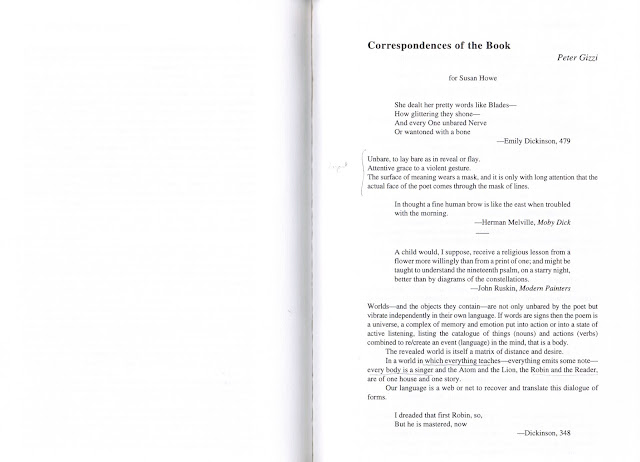


Reprinted with kind permission from Peter Gizzi. (c) Peter Gizzi


Reprinted with kind permission from Peter Gizzi. (c) Peter Gizzi
Monday, April 23, 2012
May 29 & 30 Peter Gizzi at Université Paris Est Marne-La-Vallée
 On Tuesday 29 and Wednesday 30
May, we will be hosting a 2 day symposium on Peter Gizzi’s work at Université
Paris Est Marne-La-Vallée (3rd floor of the Copernic building, room
13). How to get there? see here.
On Tuesday 29 and Wednesday 30
May, we will be hosting a 2 day symposium on Peter Gizzi’s work at Université
Paris Est Marne-La-Vallée (3rd floor of the Copernic building, room
13). How to get there? see here. 
We will be meeting in the
morning of May 29th at 10 am to prepare our sessions with Peter
Gizzi. Peter Gizzi will be joining us at 2pm on the 29th. He will
also be with us on the 30th.
So far, we’ve tried to focus
on the writer’s own (creative and critical) work on the first day of the
P&C symposia and on broader issues of poetics and practice-based criticism
with the writer on the second day. But there’s no specific preconceived program for the 2
days of the symposium: as the previous sessions of the program have shown, it
seems important to let the conversation take its own course.
 PETER GIZZI’s books include Threshold Songs (2011), The Outernationale (2007), Some Values of Landscape and Weather (2003),
Artificial Heart (1998), and Periplum (1992). He has also published
several limited-edition chapbooks, folios, and artist books and his work has
been translated into numerous languages. Over
the years, his work has been translated into French by Emmanuel Hocquard,
Juliette Valéry, Pascal Poyet, Sébastien Smirou, Pierre Alferi, Eric Giraud,
Éric Pesty, Olivier Brossard, and Stéphane Bouquet.
PETER GIZZI’s books include Threshold Songs (2011), The Outernationale (2007), Some Values of Landscape and Weather (2003),
Artificial Heart (1998), and Periplum (1992). He has also published
several limited-edition chapbooks, folios, and artist books and his work has
been translated into numerous languages. Over
the years, his work has been translated into French by Emmanuel Hocquard,
Juliette Valéry, Pascal Poyet, Sébastien Smirou, Pierre Alferi, Eric Giraud,
Éric Pesty, Olivier Brossard, and Stéphane Bouquet. His honors include the Lavan Younger Poet Award from the Academy of American Poets (awarded by John Ashbery in 1994) and fellowships in poetry from The Howard Foundation (1998), The Foundation for Contemporary Arts (1999), and The John Simon Guggenheim Memorial Foundation (2005). He has held residencies at The MacDowell Colony, Yaddo, The Foundation of French Literature at Royaumont, Un Bureau Sur L'Atlantique, the Centre International de Poesie Marseille (cipM), and Tamaas.
His editing projects have included o-blek: a journal of language arts (1987-1993), The Exact Change Yearbook (1995), The House That Jack Built: The Collected Lectures of Jack Spicer (1998), and My Vocabulary Did This To Me: The Collected Poetry of Jack Spicer (2008).
From 2007 to 2011 he was the Poetry Editor for The Nation. In 2011 he was the Judith E. Wilson Visiting Fellow in Poetry at Cambridge University. He works at the University of Massachusetts, Amherst.
> You will find below a bibliography including links to interviews and prose pieces by Peter Gizzi.
 Threshold Songs (Wesleyan, 2011)
The Outernationale (Wesleyan, 2007)
Some Values of Landscape
and Weather (Wesleyan, 2003)
GIZZI ON-LINE RESOURCES
Interviews:
POETRY FOUNDATION INTERVIEW
WITH BEN LERNER (2012)
BOMB INTERVIEW WITH LEVI
RUBECK (2011)
JUBILAT INTERVIEW WITH ROB
CASPER (2007)
PUBLISHER’S WEEKLY INTERVIEW
WITH CRAIG MORGAN TEICHER (2007)
RAIN TAXI INTERVIEW WITH
AARON KUNIN (2003)
•
Radio Interviews:
BOOKWORM INTERVIEW WITH
MICHAEL SILVERBLATT (2011)
CLOSE LISTENING INTERVIEW
WITH CHARLES BERNSTEIN (2008)
CROSS-CULTURAL POETICS
INTERVIEW WITH LEONARD SCHWARTZ (2007)
•
Sound Files:
GIZZI PENNSOUND PAGE,
READINGS, INTERVIEWS ETC.
•
Selected Prose on-line:
ON ROBERT CREELEY (2005)
ON BARBARA GUEST (2006)
INTRO TO SPICER’S 3RD
VANCOUVER LECTURE (1998)
FROM THE AFTERWORD TO THE
HOUSE THAT JACK BUILT (1998)
JACK SPICER, BRUCE CONNER
& THE ART OF ASSEMBLAGE (2002)
REVIEW OF JAMES SCHUYLER’S
COLLECTED POEMS (1993)
ON SCHUYLER’S FEBRUARY
(2002)
LETTER TO STEVE FARMER PDF (1997)
•
Sunday, April 22, 2012
From My Vocabulary Did This to Me, edited by Peter Gizzi and Kevin Killian, Wesleyan, 2008

Preface and Afterword from The House That Jack Built: The Collected Lectures of Jack Spicer

Peter Gizzi's The Outernationale
Read some excerpts from Peter Gizzi's The Outernationale (Wesleyan, 2007) below (source: google books).
Peter Gizzi's Some Values of Landscape and Weather
Read some excerpts from Peter Gizzi's Some Values of Landscape and Weather (Wesleyan, 2003) below (source: google books).
American Poets of the 21st Century: Peter Gizzi

The section of the book on Peter Gizzi's work includes poems, an essay by Peter Gizzi and "Peter Gizzi's City," an essay by Cole Swensen.
You can read most of the section of the book below or on google books here.
Subscribe to:
Posts (Atom)